Quality Assurance
Validated Quality and Safety for Hydrogen Systems
We characterize and test systems, components, and processes throughout the entire development cycle and at the end of the production line. Using multiple test laboratories and proven methodologies and analyses, we assess quality-related criteria and evaluate your hydrogen system for safety, performance, and reliability. Our quality processes are consistently aligned with industrial requirements and standards.
Engineering for your Production
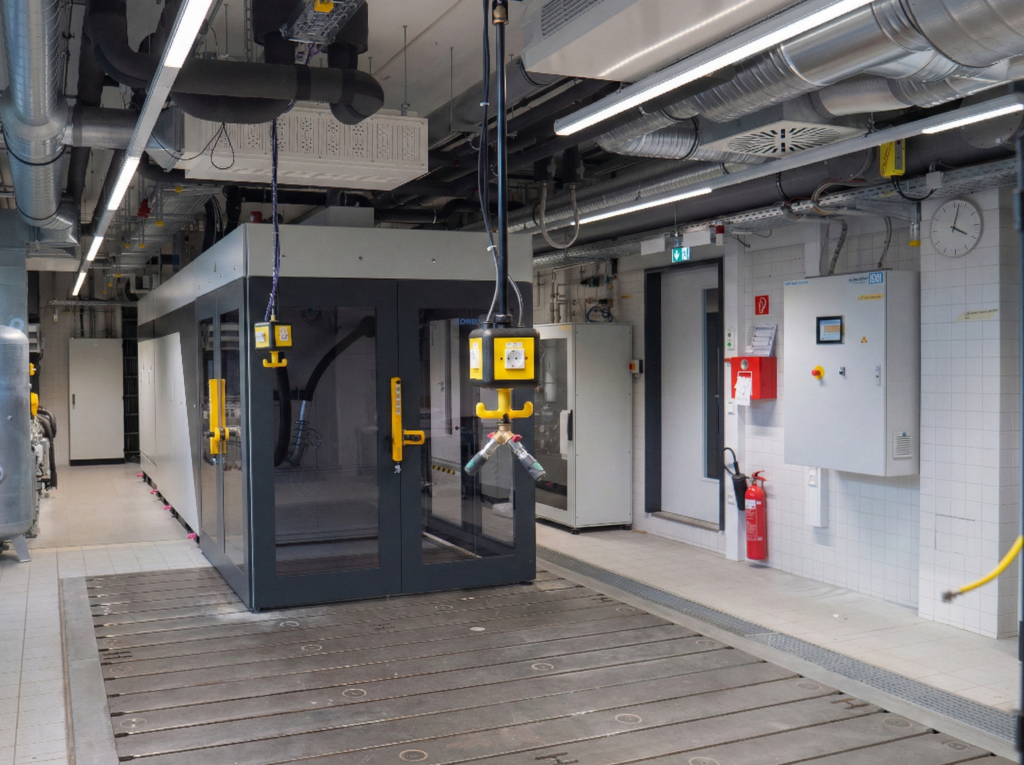
Certified Hydrogen Laboratory at Fraunhofer IWU in Chemnitz
Design for Manufacturing
Test benches are not only used to verify a manufacturing result – they also make it possible to validate the material concept before a product enters mass production. This is referred to as “design for manufacturing,” which combines quality assurance with material analysis to reduce manufacturing costs and improve the product’s functionality. A material and production concept coordinated at an early stage is essential, particularly in view of the rapid ramp-up of large-scale production of hydrogen systems.
For comprehensive testing programs in accordance with EU regulations (“harmonised standards”), U.S. regulations (“Department of Energy Technical Standards,” DoE), or individual customer requirements, there is now more than “just” a test bench available. The result is a laboratory certified in accordance with Section 15 of the Operational Safety Ordinance .

Ultrasonic cleaning
Frequency
28 kHz
Thermal capacity
4500 W
Max. dimensions of the component to be cleaned
560 x 450 x 260 mm
Media
- Hydrogen 5.0
- Ultrapure water
- Oil-free air
- Argon
- Nitrogen
Services
- Current–voltage characteristic
- AST (Accelerated Stress Tests)
- Cyclic voltammetry
- EIS (Elektrochemische Impedanzspektroskopie)
- Leakage test
- Missbrauchsversuche
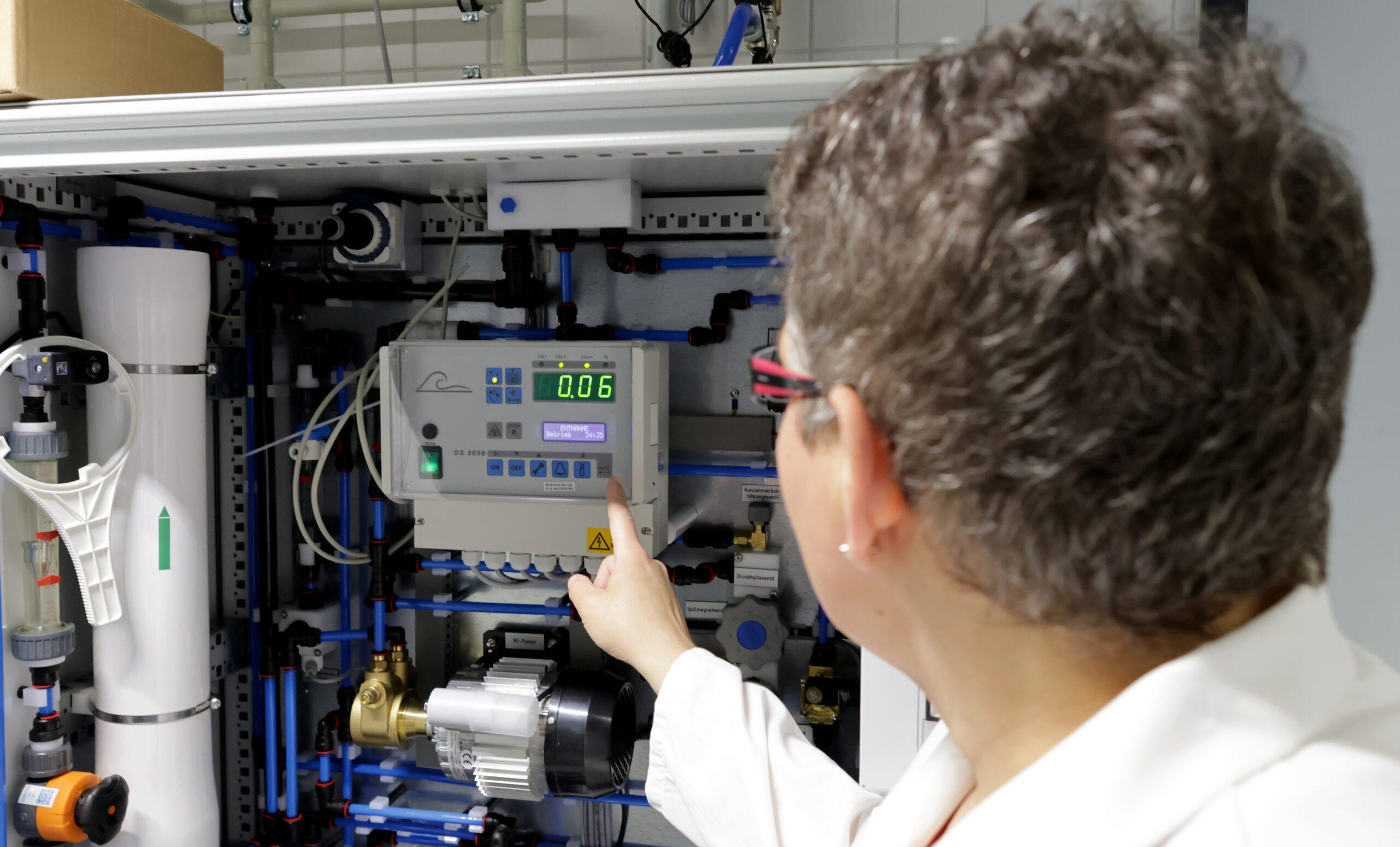
To ensure safety at all times, an automated gas monitoring system is an integral part of the hydrogen laboratory.
Out testing capabilities
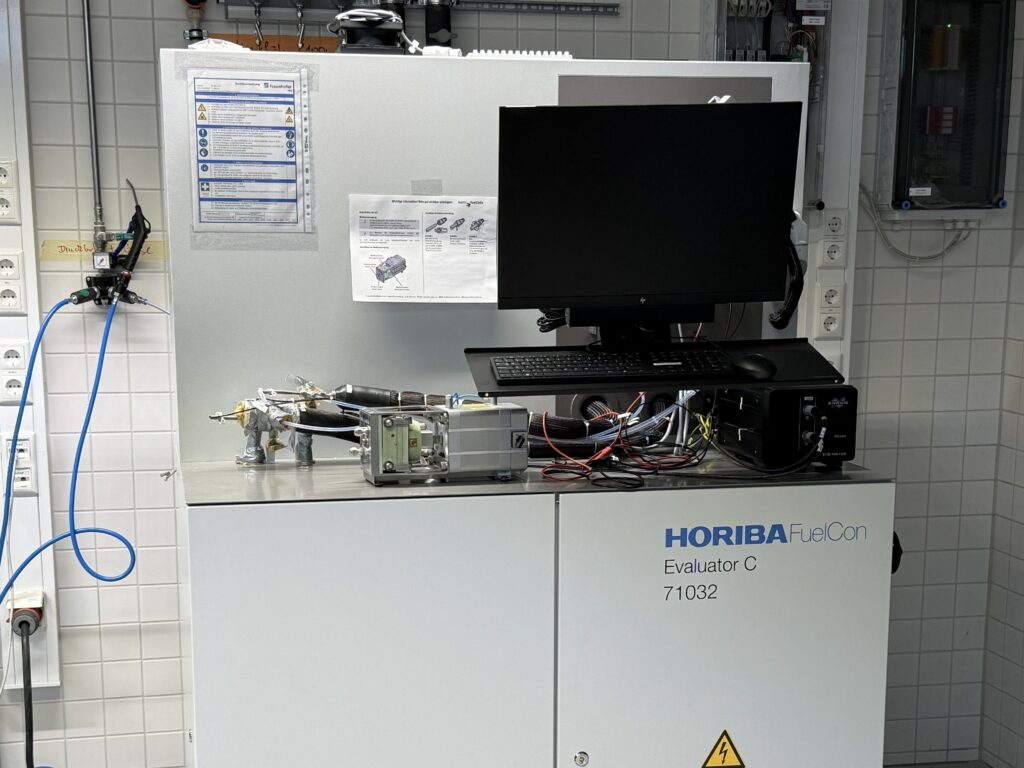
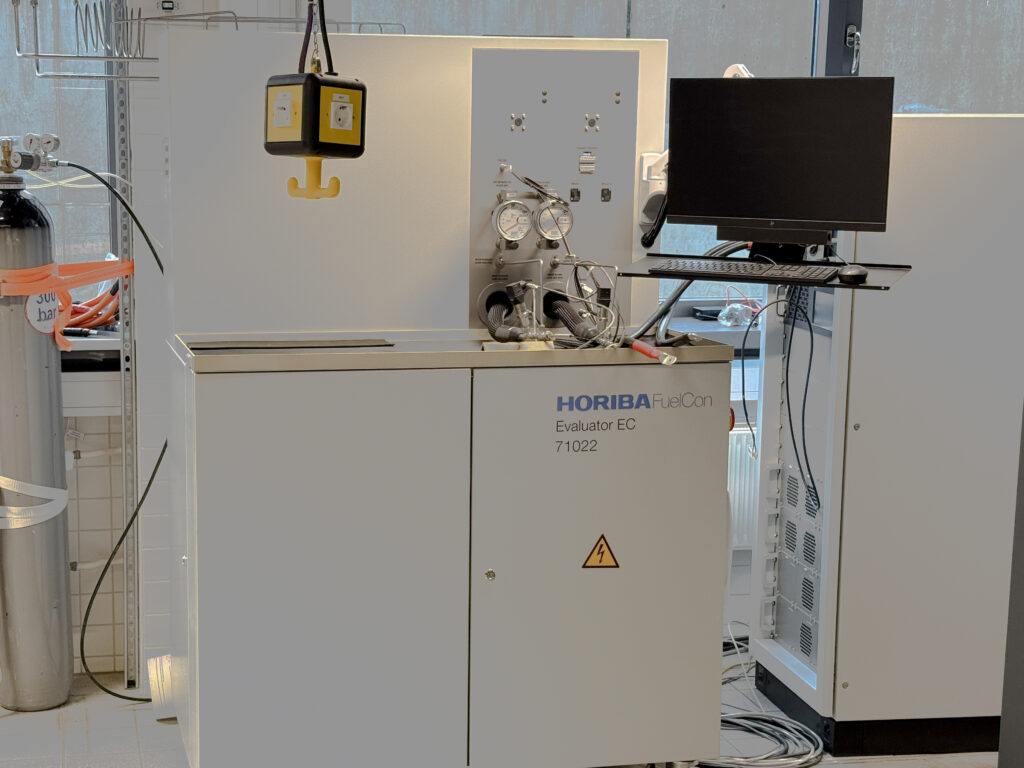
The hydrogen laboratory at Fraunhofer IWU is equipped with various test benches for characterizing and testing cells, short stacks, stacks, and systems. Contact us to have your prototypes tested here.
PEM-BZ: Horiba S100 LT
Testing of PEM fuel cell stacks in the kW range
Power
90 kW
Voltage
bis 500 V
Electric current
up to 800 A
Betriebsdruck
up to 5 Bar
Anode current
up to 2000 [Nl/min]
Cathode current
up to 4000 [Nl/min]
PEM-BZ: Horiba C50 LT
Testing of individual PEM fuel cell single cells, as well as material testing
Power
500 W
Voltage
up to 6 V
Electric current
up to 250 A
Betriebsdruck
up to 5 Bar
Anode current
up to 5 [Nl/min]
Cathode current
up to 20 [Nl/min]
PEM-EC Horiba C50 EC
Testing of PEM electrolysis single cells and stacks
Power
1000 W
Voltage
up to 6 V
Electric current
up to 400 A
Betriebsdruck
up to 50 Bar
Hydrogen flow
up to 6 [Nl/min]
Oxygen flow
up to 3 [Nl/min]
Testen Sie Jetzt Ihren Brennstoffzellen- und Elektrolyseur-Stack
In unserem Wasserstoff-Labor testen wir Brennstoffzellen bis 90 kW und Elektrolyseure bis 1 kW. Dabei prüfen wir nicht nur die Stacks, sondern das gesamte System inklusive aller Balance-of-Plant-Komponenten wie Kühlaggregate, Pumpen und Sensoren. Zur präzisen Fehlersuche führen wir zudem Impedanzmessungen durch, um Alterungsprozesse frühzeitig zu erkennen.
Bringen Sie Ihre Prototypen zu uns und lassen Sie sie unter realen Bedingungen testen. So optimieren Sie Ihre Fertigungsqualität und die Lebensdauer Ihrer Systeme von Anfang an. Lassen Sie uns gerne über Ihr Projekt sprechen.
Contact
- +49 371 5397-1365
- Vladimir.Buday@iwu.fraunhofer.de
Inline Prüfung
Effiziente Inline-Qualitätskontrolle für Elektrolyseurplatten
Unsere hochratenfähige Inline-Prüfanlage optimiert Ihre Fertigung durch maximale Präzision bei voller Geschwindigkeit. Dank intelligenter Auswertung erfolgt die Qualitätskontrolle nahtlos im Prozess, wodurch Sie Ihre First-Pass-Yield-Rate unmittelbar steigern und teure Nacharbeiten vermeiden.
Das System nutzt eine synergetische Datenfusion, um selbst verborgene Defekte an flachen Komponenten sicher zu identifizieren. Durch den modularen Aufbau und die enorme Rechenleistung lässt sich die Anlage präzise auf Ihre individuellen Anforderungen skalieren, ohne den Materialfluss zu beeinträchtigen.
Maximale Geschwindigkeit
Prüfung in < 1 Sekunde bei bis zu 500 mm/s Durchlaufgeschwindigkeit.
Präzise Sensor-Fusion
Kombination aus 2D, 3D und Wirbelstrom für lückenlose Detektion.
KI-basierte Analyse
Intelligente Algorithmen bewerten komplexe Fehlerbilder in Echtzeit.
High-End Rechenpower
Parallele Datenverarbeitung bis 2,5 GByte/s für höchste Auflösungen.
Modulares Systemdesign
Flexibel anpassbare Teilstationen, optimiert für flache Komponenten.
Höhere Wirtschaftlichkeit
Minimierung von Ausschusskosten und Steigerung der Prozessstabilität.
Inline-Prüfung für Ihre Produktion
Contact us for a no-obligation consultation about your development ideas. We’ll help you develop the technologies and processes of the future. Together, we’ll find the best solution for your challenges.
Contact
- +49 371 5397-1446
- matthias.nagel@iwu.fraunhofer.de