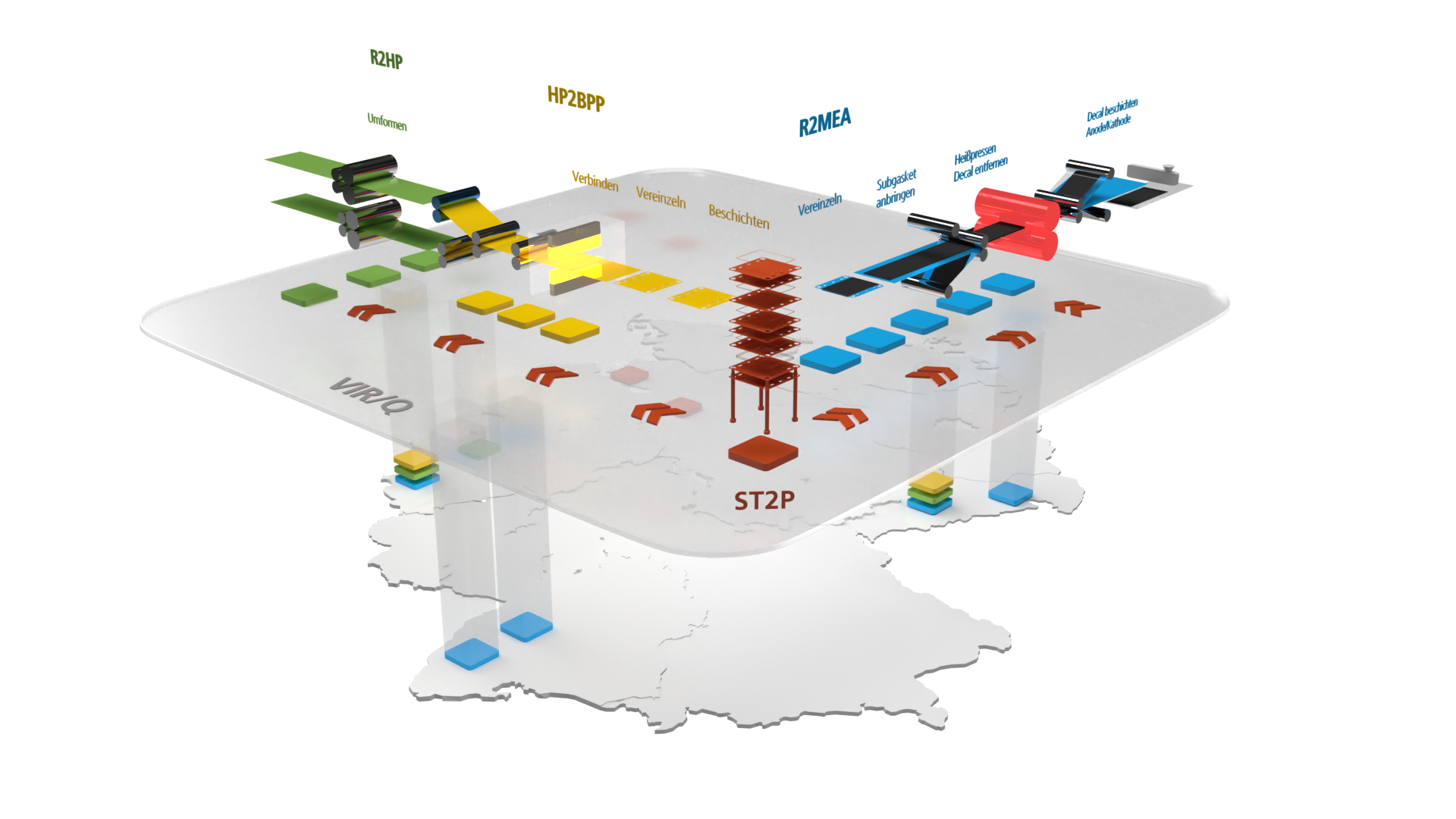
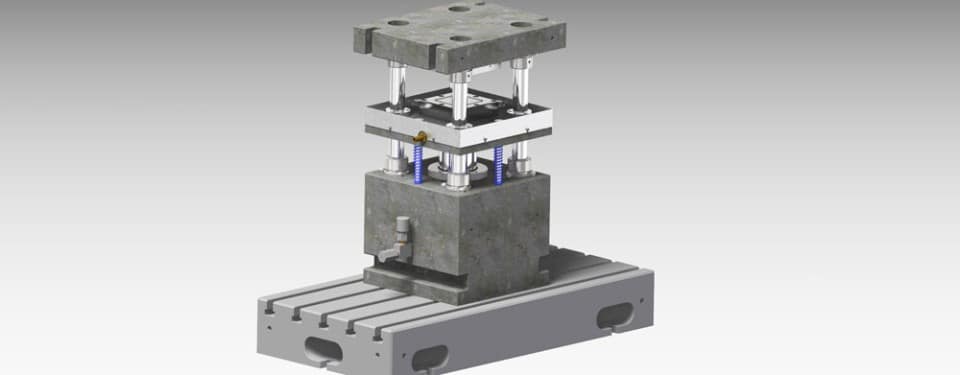
To make the ramp-up of hydrogen technology economically viable, the project developed concepts for a previously unique reconfigurable production line (DuoLine) that can first serve the demand for electrolysers based on PEM stacks and later also produce PEM stacks for fuel cells. In the process, Fraunhofer IWU realised passive high-pressure sheet forming for the first time at forming pressures above 200 MPa to manufacture demanding bipolar plate geometries.
In conventional high-pressure sheet forming, the high pressure in the working medium is generated by a hydraulic pressure intensifier and fed through a high-pressure line into the medium-carrying tool component. This setup requires a hydraulic press with an external water hydraulic system including a pressure intensifier, as well as a control system that regulates the pressure as a function of the clamping force or the clamping force as a function of the pressure.
In passive hydroforming, the pressure intensifier is integrated directly into the forming tool and thus into the force flow of the press. As the press closes, the forming tool closes first and the pressure required for forming is generated during the remaining stroke. This means the process can be carried out on a wide variety of presses. Because no external pressure intensifier is needed, significantly shorter cycle times can also be achieved than with conventional high-pressure sheet forming.
With the reconfigurable DuoLine, the same line can be used for two applications: first for the bipolar plates of PEM electrolysers and later for those of fuel cells. The project was carried out together with the partners Vitesco Technologies and Xenon Automatisierungstechnik and was funded by the European Regional Development Fund (ERDF) via the Sächsische Aufbaubank (SAB).